Sunday Worship
All are welcome to join us for Sunday worship! We gather at 9:30 AM — in-person, at 68 Main Street in Castine, or by livestream on our YouTube channel. This page offers an overview of a typical worship service at the Trinitarian Congregational Parish of Castine.
GATHERING AS A COMMUNITY OF FAITH
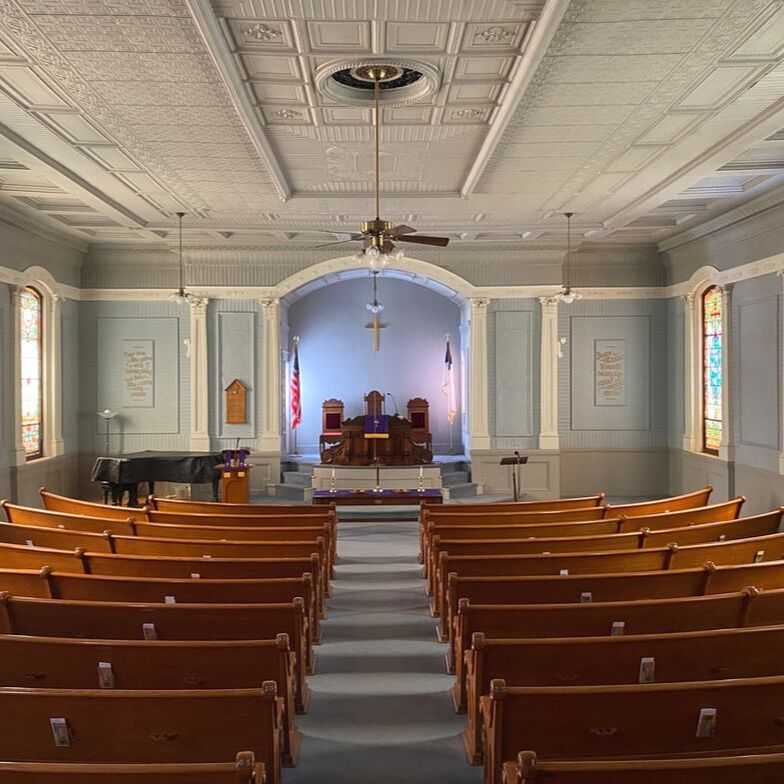
The first part of our worship brings us together and helps to focus us in a spirit of worship. This section includes several parts.
PRELUDE: As people enter our worship space, the music director, sometimes in combination with the TCP Choir or another guest musician, plays music that helps set a worshipful mood and lets people know that we are now gathering for worship.
GREETINGS AND ANNOUNCEMENTS: Before we begin worship, we take time to welcome guests and make important announcements for our community life together.
TIME OF SILENCE: A brief time of silence allows us to settle our hearts and minds for worship.
INTERLUDE: The church musician brings us out of the time of silence with a short piece of music.
PRELUDE: As people enter our worship space, the music director, sometimes in combination with the TCP Choir or another guest musician, plays music that helps set a worshipful mood and lets people know that we are now gathering for worship.
GREETINGS AND ANNOUNCEMENTS: Before we begin worship, we take time to welcome guests and make important announcements for our community life together.
TIME OF SILENCE: A brief time of silence allows us to settle our hearts and minds for worship.
INTERLUDE: The church musician brings us out of the time of silence with a short piece of music.
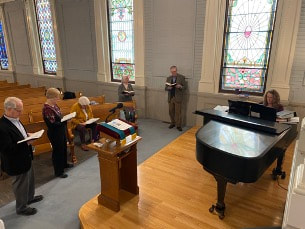
CALL TO WORSHIP: The congregation is invited to rise in body or in spirit to join in the Call to Worship, usually read responsively. This begins our formal time of worship as a community of faith.
OPENING HYMN: The singing of hymns is an ancient Christian tradition, bringing us together to offer praise, thanksgiving, or prayers to God. Theologian Augustine of Hippo (354 - 430 CE) is said to have written "For he who sings praise, does not only praise, but also praises joyously; he who sings praise, is not only singing, but also loving Him whom he is singing to.” Our hymns are generally drawn from the New Century Hymnal.
PRAYER OF INVOCATION (Unison): We continue standing as we say together our “Prayer of Invocation,” which is printed in our Order of Worship. The Invocation traditionally calls for the Holy Spirit, the presence of God, to join us in our worship. Following this prayer, we sit.
OPENING HYMN: The singing of hymns is an ancient Christian tradition, bringing us together to offer praise, thanksgiving, or prayers to God. Theologian Augustine of Hippo (354 - 430 CE) is said to have written "For he who sings praise, does not only praise, but also praises joyously; he who sings praise, is not only singing, but also loving Him whom he is singing to.” Our hymns are generally drawn from the New Century Hymnal.
PRAYER OF INVOCATION (Unison): We continue standing as we say together our “Prayer of Invocation,” which is printed in our Order of Worship. The Invocation traditionally calls for the Holy Spirit, the presence of God, to join us in our worship. Following this prayer, we sit.
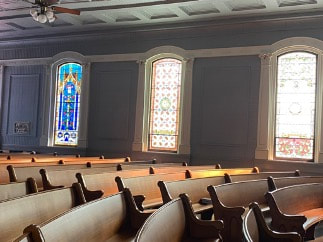
PRAYER OF CONFESSION: Confession is a time for us to look clearly at our own lives, speak the truth about the ways we have fallen short or missed the mark, and ask God for the forgiveness we need. If sin is understood as a state of separation from God, our prayer of confession expresses our desire to be reconciled with God. Our prayer of confession is answered with an assurance of grace - a reminder that we are loved and that by the grace of God in Jesus Christ, we are forgiven.
GLORIA PATRI: Following our Prayer of Confession, we sing the Gloria Patri. This short song is what we call a “doxology,” which is a short song or saying that offers praise to God: Glory be to the Father, and to the Son, and to the Holy Ghost. As it was in the beginning, is now and ever shall be, world without end. Amen. Amen.
GLORIA PATRI: Following our Prayer of Confession, we sing the Gloria Patri. This short song is what we call a “doxology,” which is a short song or saying that offers praise to God: Glory be to the Father, and to the Son, and to the Holy Ghost. As it was in the beginning, is now and ever shall be, world without end. Amen. Amen.
HEARING THE WORD
The second major part of our service involves hearing the Word of God, which we find in Scripture (the Holy Bible.) In our tradition, this is considered to be the most important part of the service. There are usually four parts to our reading of scripture, chosen each week based on a three-year rotating schedule known as the Revised Common Lectionary.
Old Testament: First, a passage is read from the Hebrew Scriptures, sometimes known as the Old Testament.
Psalm: Next, we will read responsively from the Psalter (Book of Psalms), a collection of 150 ancient songs collected in the Bible. The psalms are meant to be sung or prayed; reading responsively from the Psalms is an ancient practice.
Epistle: Following the reading from the Psalms, we read a passage from the Epistles, which is a group of letters and sermons written after the life and ministry of Jesus. These letters help us better understand how new Christians lived following the time of Jesus, and what our Christian church came to believe about his life, ministry, death, and resurrection.
Musical Response: After the reading from the Epistles, a short musical interlude offers a moment to pause and reflect on what we've heard.
Gospel: Finally, we read from the Gospel (the four books in the New Testament that tell about the life of Jesus: Matthew, Mark, Luke, and John). Each year, the lectionary follows one Gospel account closely, rotating between Matthew, Mark, and Luke, with John's Gospel appearing at key moments in each year.
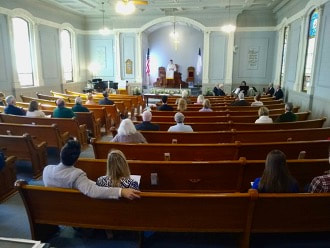
Sermon: We continue with the Sermon, which reflects on one or more passages from the Scripture readings. The sermon begins with a prayer of illumination, which acknowledges that preaching is Spirit-driven and Spirit-dependent. Here's the prayer that Pastor Andi prays. May the words of my mouth and the meditations of our hearts be acceptable in Your sight. O God, you are our rock and our redeemer.
THE OFFERING OF OUR GIFTS
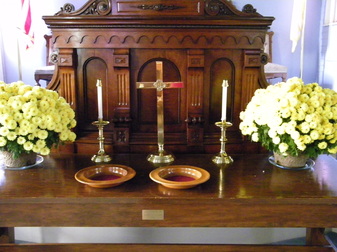
The Offering of our Gifts is where we collect what is offered by our congregation in the form of pledges, special offerings, or simply whatever money they may wish to donate in order to support our work, here in the world, in God’s name. A deacon offers an invitation, collection plates are passed.
While the collection plates are passed, our talented musicians — the TCP choir, the music director, or another guest musician from among our midst — will offer an anthem. Once the collection plates have been passed, we rise, in body or spirit, as we sing this Doxology together:
Praise God from whom all blessings flow;
Praise God, all creatures here below;
Praise God above, you heavenly host:
Praise Father, Son, and Holy Ghost. Amen.
Following the Doxology, we pray together a Prayer of Dedication.
While the collection plates are passed, our talented musicians — the TCP choir, the music director, or another guest musician from among our midst — will offer an anthem. Once the collection plates have been passed, we rise, in body or spirit, as we sing this Doxology together:
Praise God from whom all blessings flow;
Praise God, all creatures here below;
Praise God above, you heavenly host:
Praise Father, Son, and Holy Ghost. Amen.
Following the Doxology, we pray together a Prayer of Dedication.
THE CHURCH AT PRAYER
Congregational prayer is an opportunity for us to bring to God our gratitude, our praise, our joys, and our concerns.
Celebrations & Concerns: Congregational prayer begins with an invitation to share any prayers of joy or concern — for members of our own community, loved ones near and far, and for people and places around the world.
Pastoral Prayer: Following this time of congregational sharing, the pastor offers a pastoral prayer that weaves together thanksgiving, expressions of joy, and expressions of sorrow or concern. The pastoral prayer concludes with the praying of the Lord's Prayer, aloud and in unison. Our Father, who art in heaven, hallowed be thy name. Thy kingdom come. Thy will be done on earth as it is in heaven. Give us this day our daily bread. And forgive us our trespasses, as we forgive those who trespass against us. And lead us not into temptation, but deliver us from evil. For thine is the kingdom, and the power, and the glory forever. Amen.
Celebrations & Concerns: Congregational prayer begins with an invitation to share any prayers of joy or concern — for members of our own community, loved ones near and far, and for people and places around the world.
Pastoral Prayer: Following this time of congregational sharing, the pastor offers a pastoral prayer that weaves together thanksgiving, expressions of joy, and expressions of sorrow or concern. The pastoral prayer concludes with the praying of the Lord's Prayer, aloud and in unison. Our Father, who art in heaven, hallowed be thy name. Thy kingdom come. Thy will be done on earth as it is in heaven. Give us this day our daily bread. And forgive us our trespasses, as we forgive those who trespass against us. And lead us not into temptation, but deliver us from evil. For thine is the kingdom, and the power, and the glory forever. Amen.
GOING FORTH INTO THE WORLD
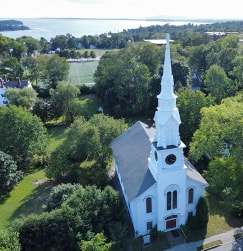
Where our worship ends, our work begins. As our regular benediction reminds us, we are sent to do God's work in the world.
Go forth into the world to serve God with gladness;
be of good courage; hold fast to that which is good;
render to no one evil for evil; strengthen the fainthearted;
support the weak; help the afflicted;
honor all people; love and serve God,
rejoicing in the power of the Holy Spirit.
Go forth into the world to serve God with gladness;
be of good courage; hold fast to that which is good;
render to no one evil for evil; strengthen the fainthearted;
support the weak; help the afflicted;
honor all people; love and serve God,
rejoicing in the power of the Holy Spirit.
Click here to return top the top of this page.